 Open Historia
Espionage
Intelligence ratings, sending agents, being spied on, double agents and sealed intercepts.
Espionage runs in both directions. You plant agents in other countries and read their private diplomacy; other countries plant agents in you and read yours. It is the most mechanically explicit system in the game — the rolls are real numbers, and they are deterministic.
Find it in the Chat panel, Spy tab. (A scenario can switch espionage off with its Espionage feature; then the Spy tab is hidden and no service acts.)
On beta the tab is called Intelligence, beside Contacts and Institutions, and it has four sections. Overview rates your service in a word, counts your active networks, current reports and counterintelligence alerts, and lists strategic warnings and the latest intelligence. Countries keeps a dossier on every country: how strong your network, political, diplomatic and source picture of it is, its public political picture, its institutional position and your intelligence assessment. Operations holds your networks and their orders, the Operations log, the foreign agents you have caught, and ♟ Deploy a network. Reports files political assessments, intercepted traffic and documents. An agent is called a network there; it is the same thing.
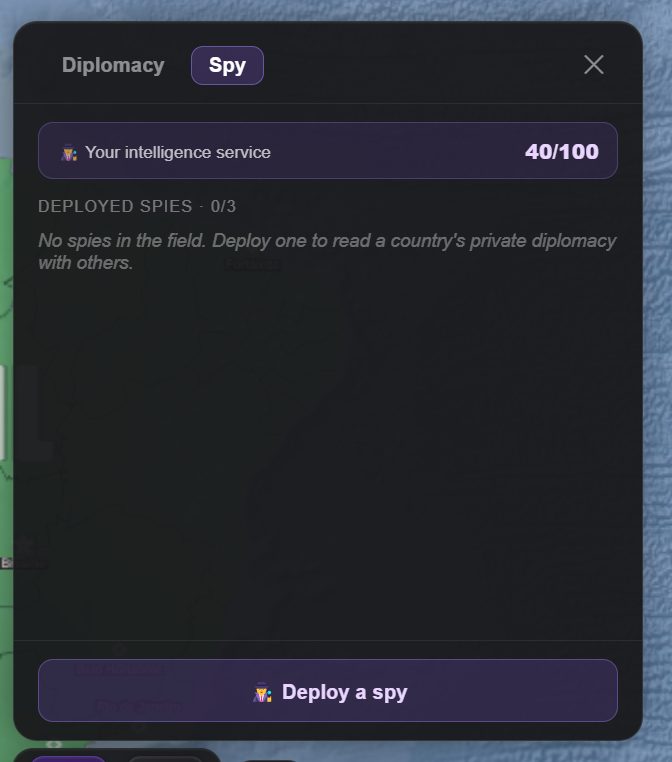 The Spy tab before anything is deployed — your service rating, and the three slots you have to spend.
Intelligence rating
Every country has an intelligence rating from 0 to 100. It is the single number that decides how good its service is at everything below: planting agents, catching yours, turning the ones it catches, noticing when its own have been turned, and reading intercepted traffic.
The default is 40 — deliberately "ordinary", not "none". A country with no rating yet gets one assessed the first time it matters: when you open its stats, send an agent there, read an intercept from it, or catch one of its agents.
Your own rating is on your stat sheet: the Stats tab of the advisor drawer, or on beta the country panel your flag opens. Raising it is a matter of governing that way — order intelligence expansion, fund the service, make it a priority — and it moves like any other national statistic.
On beta the Intelligence tab puts your service in a word: Minimal below 30, Developing from 30, Limited from 50, Capable from 70 and Advanced from 85.
Limits
| Agents you can have active | 3 |
| Foreign agents inside you at once | 3 |
| Agents per target country | 1 |
| Spying on yourself | Not possible |
Three is not many. Choosing where those three go is most of the strategy.
Sending an agent
From the Spy tab, deploy to a target country. You can also just write it as an order — "deploy a spy in Germany" — and the next time skip places a real agent through exactly the same rules and caps, quietly on the turn it happens; an order can also give the officer a cover, who they pose as. Either way the agent's operation opens on your Projects board the same turn, and recalling or losing it closes it.
An active agent reports: it feeds you the target's private diplomatic traffic, subject to how much of it you can actually read.
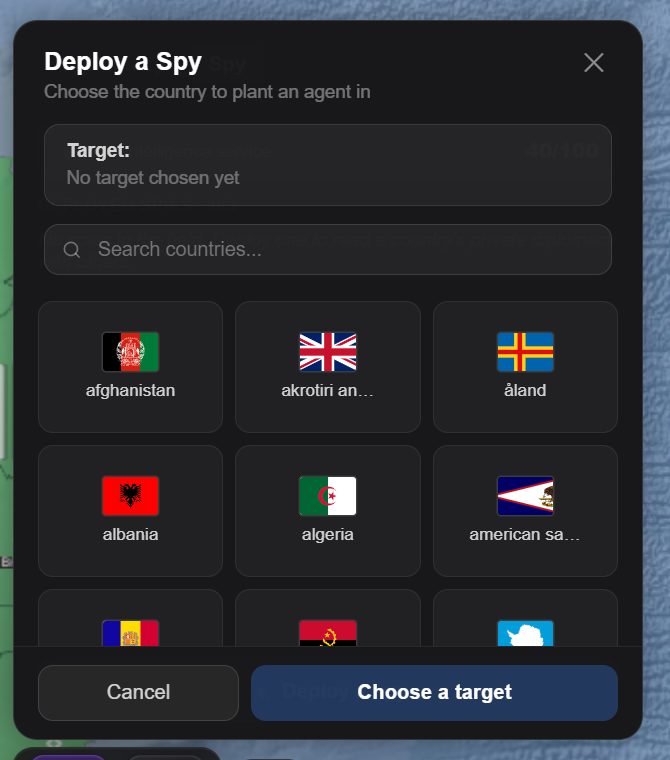 The target picker. Countries you already have an agent in are not offered again — one agent per
country, and never yourself.
You can recall an agent at any time, and see everything it has sent.
On beta you deploy from the Operations section, with ♟ Deploy a network. Each network there says how well it reads its target — Strong, Moderate or Limited — with Dossier and Recall beside it, and takes orders: see orders and operations below.
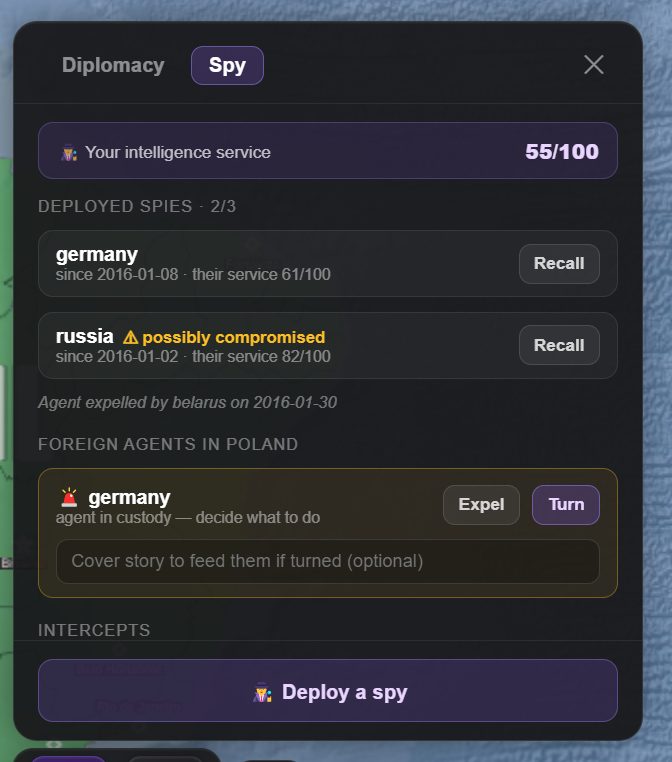 Every state at once: an agent running in Germany, one flagged possibly compromised, a line
recording one Belarus expelled, and a German agent caught inside Poland waiting on your decision —
expel it, or turn it and write what it reports home.
Getting caught
Every jump, each of your agents is rolled against the target's service.
The chance of detection is driven mostly by the gap between the two services:
detection = 0.04 + (target/100 − yours/100) × 0.25 + (target/100) × 0.10
            clamped to between 2% and 60%
Read that as: a service much better than yours will find your agent quickly; a service much worse will mostly not. But there is a floor of 2% — a brilliant agent in an incompetent country is never perfectly safe — and a ceiling of 60%, so even a hopeless agent is not guaranteed to be caught on day one.
Some worked numbers, per jump:
| Your service | Their service | Chance your agent is caught |
|---|---|---|
| 40 | 40 | 8% |
| 40 | 80 | 22% |
| 80 | 20 | 2% (the floor) |
On beta, sources and operations change the roll. Each recruited source a network runs cuts this chance by a tenth, and a network that carries out an operation during a skip is not rolled that skip: the operation's own risk of capture decides it.
Caught, then what
A caught agent becomes discovered and stops reporting. The target then either turns it or expels it:
turn chance = (target intelligence / 100) × 0.6
              clamped to between 5% and 60%
Turning takes skill. An ordinary service mostly just throws your agent out; a very good one keeps it.
Who sent them
Beta channel only.
On beta, a caught agent is not always made to say who sent it. The service that caught it learns whose agent it is with this chance:
identified = 0.6 + (catcher/100 − sender/100) × 0.5
             clamped to between 20% and 90%
An identified agent goes on as above: turned or expelled. One that is not identified dies under interrogation, and the trail ends there — the country that caught it never learns who sent it. Your Operations section keeps a line for it, caught, and died in custody without giving you away, and its entry on the Projects board fails with a note that the agent has gone silent.
The turned agent
This is the part worth understanding properly.
You are never told that your agent has been turned. From your side it looks like it is still reporting. What it is actually sending is material the target wrote for you.
Each jump, your own service gets a chance to notice:
suspicion = 0.05 + (yours/100 − target/100) × 0.3
            clamped to between 2% and 50%
So a service better than the one that turned your agent will usually spot it eventually. A service much worse may never.
The game itself always knows — reports produced while an agent was turned are permanently marked as planted — but that mark is not shown to you. It exists so that the consequences are consistent later.
The practical lesson: intelligence you cannot corroborate is not intelligence. If a single agent is telling you something convenient, and your service is weaker than theirs, consider that you may be reading fiction written for you.
Being spied on
Other countries plant agents in you, on their own initiative, every jump:
deploy chance = (their intelligence / 100) × 0.12 + hostility × 0.2
                capped at 40%
A capable service does it as a matter of course. A hostile one goes looking. At most three foreign agents can be inside you at once.
When you catch one, it appears in the Spy tab and waits for your decision:
- Expel it. Clean, final, and it tells the other country you found them.
- Turn it. It becomes a double agent, and from then on you write what it reports home. The country that sent it is not told.
Turning is the more interesting option and the more useful one, but it requires you to keep feeding it plausible material.
Typing a story before you turn the agent changes the button to Turn & plant story, so the first report home is yours from the start. A turned agent's Save is greyed out while the field matches what it already reports and reads "Saved" for a moment after you save; Enter in the field saves too.
On beta, your service has to identify them too. A foreign agent you catch is identified by the same chance as under Who sent them, with your service as the catcher. One that is never identified dies under interrogation: there is no one to expel or turn, and the Operations section notes only that a foreign agent died and who sent them was never learned. When your service does learn who sent one, it waits under Counterintelligence cases in the Operations section, and you decide as before.
Reading intercepts
You rarely get a clean transcript. How much of an intercepted message you can read depends on both services:
clarity = 0.12 + (yours/100) × 0.88 − (theirs/100) × 0.35
          clamped to between 6% and 100%
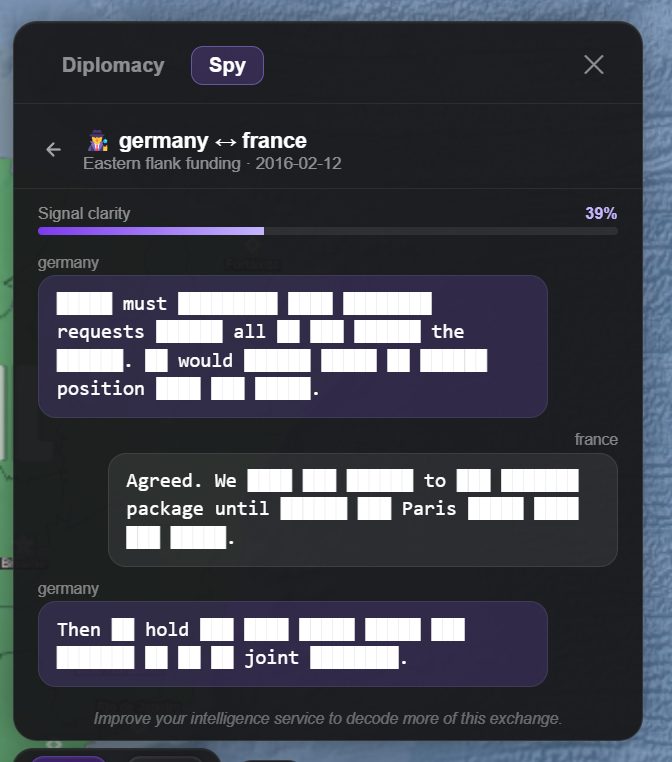 An intercept read at 39% clarity. The formula above gives exactly that for a service of 55
reading one of 61:
0.12 + 0.55×0.88 − 0.61×0.35. Punctuation survives; the words do not.
Unreadable words are blanked out, but punctuation and sentence rhythm survive, so you can often tell the shape of what was said even when you cannot read it. Raising your intelligence rating only ever reveals more of a message you have already seen — it never re-hides anything.
| Your service | Their service | How much you can read |
|---|---|---|
| 40 | 40 | 33% |
| 80 | 40 | 68% |
| 20 | 80 | 6% (the floor — essentially nothing) |
Intercepts are stored separately from the rest of your save and encrypted at rest with a key unique to your campaign. They are decrypted only to show you and to inform the simulation. An undone turn, or an Intervene, takes the turn's reports back with it.
Clarity on beta
Beta channel only.
On beta how much you can read rests on your own service, on a steep curve, and the target's service resists it only lightly:
clarity = 0.07 + (yours/100)^1.6 × 0.92 − (theirs/100) × 0.10
          never below 4%
A world-class service reads nearly every word; a weak one gets scraps. The intercept pictured above would read at 36%.
| Your service | Their service | Stable build | Beta |
|---|---|---|---|
| 40 | 40 | 33% | 24% |
| 60 | 40 | 51% | 44% |
| 80 | 40 | 68% | 67% |
| 100 | 40 | 86% | 95% |
| 100 | 100 | 65% | 89% |
| 20 | 80 | 6% | 6% |
A network reads as Strong from 72% clarity, Moderate from 46% and Limited below that.
Stolen documents
Some things governments know are not on the public record at all — a secret protocol, a private letter between heads of state, the full articles of a treaty. When such a document is held by a government where you have an active agent, your agent brings you a copy: it is filed in the Spy tab with the agent's intercepts, sealed like them, and readable only as far as your service can read theirs. A turned agent brings nothing real. The country you stole it from is never told.
On beta every paper your government holds is in one place: the Intelligence tab's Reports section lists them under Documents on file, a stolen one marked as an intercepted copy, and opens each one's text there.
On beta, agents can uncover covert puppets. An active agent inside either party to a covert puppet arrangement reveals it at the end of the turn, and keeps what you know of it current for as long as it stays in place.
Agents report in real time
Agents report after time skips — their reports come back in the skip's own answer, at no extra request, and each agent files at least every third skip. They also report between skips: while the game is open and on screen, each deployed agent is rolled roughly once a minute, working out to about one report every twenty minutes per agent. Those in-between reports are background AI, so they only happen while Background AI is on, and stop at its daily cap.
This is deliberate and it is why there is no "gather intelligence" button: an agent is a trickle of information you receive over time, not a resource to farm on demand. Leaving the game open during a tense period genuinely gets you more.
Agents at war
Beta channel only.
On beta, an agent of yours inside a country on the other side of a battlefield sends you its staff's planned movements: the War Room lists them, From your agent in that country. A turned agent sends what it is fed — the other side's diversions, or plans made up for it — and nothing in what arrives says which.
It cuts both ways. An agent of theirs you have not caught sends them your real plans, and the diversions you draw in the War Room reach them only through an agent of theirs you have turned.
Orders and operations
Beta channel only.
On beta your agents take orders. Every network in the Operations section carries two: what it collects on, and one operation for the next time skip.
What a network collects on
Collect on sets where a network looks: Diplomacy (the default, and the private traffic described above), Military, Research and technology, Economic policy or Internal politics. Most of each report then bears on it: the intercepted exchanges wherever they touch that subject, and the findings of any political assessment that comes with them, filed under Reports. Change it whenever you like; the next report follows it.
Ordering an operation
Choose Sabotage, Recruit, Assassinate or Other operation, say in a line what the agent should do — what to sabotage, whom to recruit, who the target is — and press Give the order. Under the field the network shows its Odds of success (Good, Even, Poor or Slim) and its Risk of capture (Low, Moderate or High) before you commit. A network holds one order at a time. It waits, marked Carried out during the next time skip, and Cancel order withdraws it until then.
The odds come from the two services and the network's recruited sources:
success = base + (yours/100 − theirs/100) × 0.6 + sources × 0.05
          clamped to between 5% and 90%

capture = detection × risk − sources × 0.03, plus 0.15 if it failed
          clamped to between 4% and 85%
Here detection is the per-jump chance from Getting caught, and each kind of operation has its own base and risk:
| Operation | Base | Risk |
|---|---|---|
| Sabotage | 50% | × 2.2 |
| Recruit | 45% | × 1.6 |
| Assassinate | 30% | × 3 |
| Other operation | 50% | × 1.8 |
Success reads Good from 70%, Even from 45%, Poor from 25% and Slim below; capture reads High from 45%, Moderate from 20% and Low below. The risk shown is the risk if the operation succeeds — a failed one is 15 points likelier to be caught. With your service and theirs both at 40 and no sources: sabotage is Even (50%) at Low risk (18%, or 33% if it fails), a recruitment Even (45%) at Low risk (13%), and an assassination Poor (30%) at Moderate risk (24%). A caught agent is then identified 60% of the time.
What the world sees
The operation is carried out during the next time skip. The game decides how it went before the skip is written, and the skip is told only the result:
- Succeeded and never traced. The skip writes the event it makes — the fire at the shipyard, the death, the defection — with its consequences, and nobody in the world, the target included, knows who was behind it, then or later. The skip is not even told that you have an agent there.
- Failed and nobody noticed. Nothing happens.
- Caught, and never identified. The arrest and the agent's death in custody make an event, with no culprit named. Your network is lost.
- Caught and identified. The arrest makes an event naming you, and the story goes on from there between you and the target. Your agent is expelled.
A recruitment that succeeds untraced makes no public event at all: the person simply works for you from then on.
A network that was turned without your knowing never carries an order out. The target knows you gave it; the Operations log says only that the agent reports it could not be done.
Recruited sources
A successful, untraced recruitment adds the person you named to the network as a recruited source, listed under it. A network runs up to three; a fourth replaces the oldest. Each source:
- cuts the network's chance of being caught on an ordinary jump by a tenth;
- adds 5 points to the success of its operations and takes 3 off their risk of capture;
- feeds its reports: at least one finding in each comes from a source, and says what that source could know.
The Operations log
Under your networks, the Operations log shows the eight most recent operations, newest first: the kind and the target, what you ordered, the date and what it came to — Succeeded, and was never traced, Failed, and nobody noticed, Succeeded, but the agent was caught and died in custody without giving you away, and so on. Above it is a line for each of your last three agents expelled or lost.
Using them well
- Recruit before you strike. Sources make every later operation likelier and safer, and keep the network itself alive longer.
- An assassination is the loudest order you can give. It has the lowest odds and triples the network's ordinary chance of being caught; give it with a strong service, against a weaker one.
- Untraced is the point. An operation that is never traced is never tied to you; one that is traced and identified is an incident with your name on it.
Playing it well
- Raise the rating before you rely on the service. At 40 you can barely read what you steal and you are caught reasonably often. Intelligence capability is worth ordering as a programme.
- Three agents means three priorities. Put them where a surprise would actually hurt you.
- Recall an agent that has done its job. Every jump it stays is another detection roll.
- Turn the agents you catch rather than expelling them, if you can afford the attention.
- Distrust a lone source, especially against a stronger service.
Next
- Diplomacy — the conversations your agents are reading.
- National statistics — where the intelligence rating lives.
- Projects and operations — running covert work as a long programme.
Open Historia is under active development on two channels, and this
wiki is written by hand — a page can fall behind a release. Last checked against the game on 2026-10-25 · main 6e6239c4 · beta d7e8fa85. If something
here does not match what you see in the game, trust the game and
say so on Discord.